

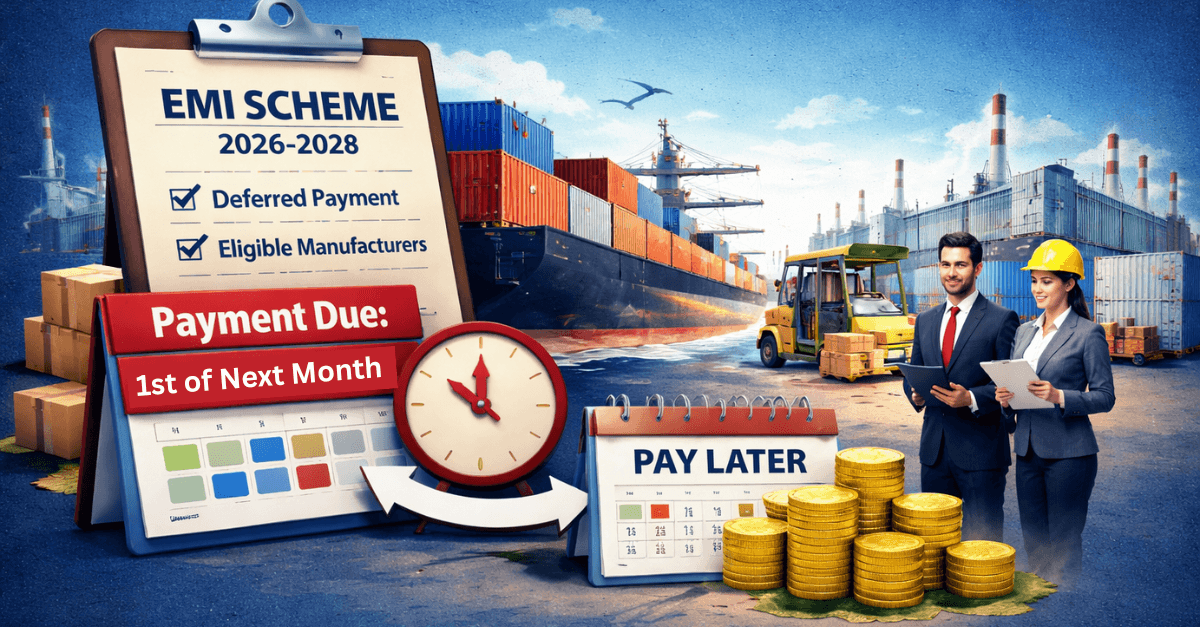
In a move aimed at improving liquidity and easing working capital pressures for manufacturers, the Central Board of Indirect Taxes and Customs (CBIC) has introduced a new framework allowing deferred payment of customs duties for certain importers.
Through Notification No. 12/2026-Customs (N.T.), issued as part of the Union Budget 2026, the Government introduced the Eligible Manufacturer Importer (EMI) Scheme. This mechanism enables approved manufacturing importers to defer payment of import duties instead of paying them at the time of clearance of goods.
The scheme will operate from 1 April 2026 to 31 March 2028 and is implemented under Section 47(1) of the Customs Act, 1962, read with the Deferred Payment of Import Duty Rules, 2016.
By allowing delayed payment of duty obligations, the scheme aims to reduce working capital constraints and improve operational flexibility for manufacturing businesses.
What the EMI Scheme Allows
Under the traditional customs process, importers must pay applicable customs duties before goods are cleared.
The EMI Scheme modifies this process for approved entities.
Under this framework:
- Eligible manufacturers can clear imported goods without immediate payment of customs duty
- Duty payments are deferred and settled later within the prescribed payment cycle
- Businesses can retain liquidity and allocate funds toward production and supply chain operations
Instead of blocking working capital at the port, businesses can utilize funds for manufacturing, procurement, and operations until the duty becomes due.
Why the Scheme Is Temporary (2026–2028)
The EMI Scheme has been introduced as a time-bound policy measure rather than a permanent reform.
1. Policy Pilot Phase
Deferred duty allows cargo clearance before revenue collection, introducing fiscal risk. A temporary window enables authorities to evaluate:
- Compliance behaviour
- Operational effectiveness
2. Transition Toward Trusted Trader Framework
The scheme acts as a transition toward the Authorized Economic Operator (AEO) ecosystem, encouraging businesses to:
- Strengthen compliance systems
- Move toward AEO certification
Legal Background: Deferred Duty Before 2026
The concept of deferred customs duty payment is not new.
Previously, this facility was available only to companies certified under the Authorized Economic Operator (AEO) Programme.
Specifically:
- Importers with AEO-T2 or AEO-T3 status could defer duty under Rule 4 of the Deferred Payment of Import Duty Rules, 2016
Limitations of the Earlier System:
- Extensive compliance documentation required
- Time-consuming certification process
- Mostly accessible to large multinational corporations
The EMI Scheme extends this benefit to non-AEO but compliant manufacturers, including MSMEs.
Understanding AEO-T2 and AEO-T3
AEO-T2
Companies with strong compliance history and internal controls.
Benefits:
- Reduced inspections
- Faster cargo clearance
- Priority customs treatment
AEO-T3
Highest level of certification with robust compliance and secure supply chain practices.
Additional Benefits:
- Minimal customs intervention
- Faster cargo release
- Eligibility for deferred duty payment
Comparison: Earlier vs EMI Scheme
| Particulars | Earlier System | EMI Scheme |
| Duty Payment | Immediate | Deferred |
| Payment Method | Transaction-wise | Periodic (Monthly) |
| Working Capital | Blocked | Retained |
| Eligibility | AEO only | Approved manufacturers |
Eligibility Conditions for EMI Approval
To safeguard revenue, the scheme prescribes strict eligibility criteria.
1. Manufacturing Requirement
- Must be engaged in manufacturing or processing
- Imports should be used in production
- Job work under Section 143 of CGST Act allowed
- Pure trading entities are generally not eligible
2. Statutory Registrations
- Valid Importer Exporter Code (IEC)
- At least one active GST registration
3. Customs Transaction History
- Minimum 25 Bills of Entry/Shipping Bills (previous FY)
- MSMEs: Relaxed to 10 documents
4. Minimum Turnover
- Annual turnover exceeding ₹5 crore
5. Business Track Record
- Operational for at least 2 financial years
6. Compliance History
- Timely GST filings
- No serious offences, prosecution, or arrests
7. Financial Stability
- Positive net worth
- Chartered Accountant certification
8. Legal Standing
- No fraud records
- No insolvency or bankruptcy proceedings
Who Cannot Avail the Scheme
The EMI Scheme is not available to:
- Pure trading companies
- Importers with compliance violations
- Entities with fraudulent history
- Businesses with revoked EMI approval
- Service-only companies (unless also manufacturing)
Practical Benefit Despite IGST Requirement
The deferred payment applies primarily to Basic Customs Duty (BCD), while IGST must still be paid upfront.
Illustration:
| Component | Rate | Amount (₹100 Cr Import) |
| Basic Customs Duty | 10% | ₹10 crore |
| IGST | 18% | ₹19.8 crore |
Since IGST is usually available as Input Tax Credit (ITC), the real working capital benefit comes from deferring BCD.
Payment Timeline Under the EMI Scheme
Duties for imports in a month must generally be paid by the:
→ 1st day of the following month
(Exception: March – payment within the same financial year)
| Import Period | Payment Deadline |
| Monthly imports | 1st of next month |
Failure to comply may result in:
- Suspension of EMI facility
- Withdrawal of approval
Example of Duty Payment
A company imports goods in April:
| Date | Duty Payable |
| 5 April | ₹5,00,000 |
| 10 April | ₹3,00,000 |
| 14 April | ₹2,00,000 |
Total Deferred Duty: ₹10,00,000
➡ Payment Due Date: 1 May
Determining the Relevant Date
As per Section 47 of the Customs Act, 1962:
- Duty becomes payable upon clearance for home consumption
- The Out-of-Charge date determines the payment cycle
Example:
- Goods arrive: 1 July
- Cleared: 10 July
➡ Payment cycle starts from 10 July, not arrival date
Global Comparison of Deferred Duty Systems
| Country | Program | Payment Cycle | Eligibility |
| India | EMI / AEO | Monthly | Approved manufacturers |
| USA | Periodic Monthly Statement | Monthly | Registered importers |
| EU | Deferred Payment Authorization | ~30 days | Approved/AEO |
| Japan | AEO Importer | Monthly | Certified importers |
| Singapore | GIRO System | Monthly | Approved GST traders |
This reflects a global shift toward trusted trader frameworks.
Scenario Under EMI Scheme
If a company imports:
| Import Value | Duty Rate | Duty |
| ₹50 crore | 10% | ₹5 crore |
Under EMI:
- Goods cleared immediately
- Used in production
- Duty paid later (next month)
Benefits:
- Improved liquidity
- Better production planning
- Efficient supply chain management
What Happens if Duty Is Not Paid on Time
Non-compliance may result in:
- Suspension or revocation of EMI approval
- Loss of deferred payment benefit
- Recovery proceedings and penalties
Strict internal tracking of deadlines is essential.
Conclusion
The Deferred Customs Duty Payment facility under the EMI Scheme represents a significant step in modernizing India’s customs framework.
By allowing compliant manufacturers to defer duty payments, the Government has:
- Improved working capital efficiency
- Enhanced operational flexibility
- Maintained strong compliance safeguards
For manufacturers engaged in regular imports, this scheme offers meaningful liquidity advantages, while its structured eligibility criteria ensure that benefits are limited to financially sound and compliant businesses.