

Introduction
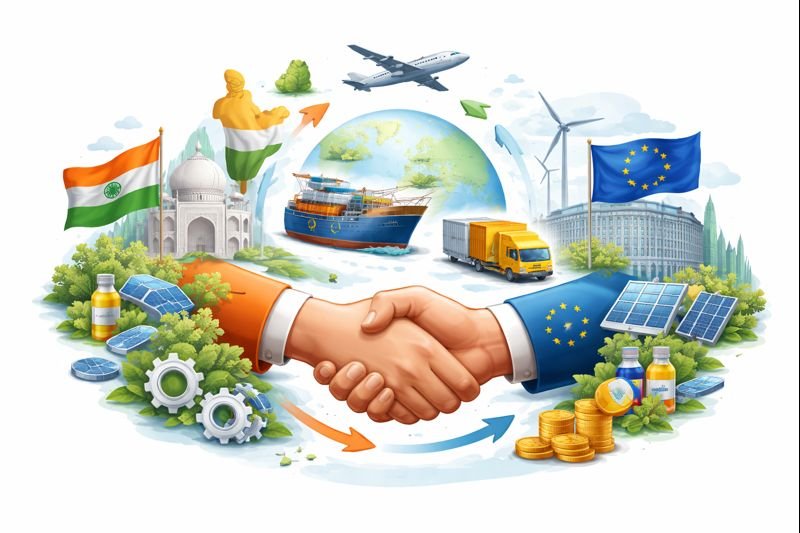
After nearly two decades of negotiations, the India–European Union Free Trade Agreement (India–EU FTA) has reached a historic breakthrough. Often described as the “Mother of All Trade Deals,” this agreement represents one of the most comprehensive and ambitious trade partnerships India has ever pursued. The conclusion of negotiations in January 2026 marks a turning point in India’s global economic integration, redefining trade, investment, and strategic cooperation between two major economic blocs.
This blog explores what the India–EU FTA is, how it evolved, what has been finalized, and why it matters for businesses, governments, and citizens.
What is the India–EU Free Trade Agreement?
The India–EU FTA is a Broad-based Trade and Investment Agreement (BTIA) designed to liberalize trade in goods and services, reduce tariffs, promote investments, protect intellectual property, and enhance regulatory cooperation between India and the 27-nation European Union.
Unlike a simple tariff-cutting agreement, this FTA covers:
- Trade in goods
- Trade in services
- Investment protection
- Intellectual Property Rights (IPR)
- Government procurement
- Sustainability and environmental standards
- Labour and social compliance
Its goal is to create a deeper economic partnership rather than just boosting exports and imports.
What Has Been Decided?
India and the EU have successfully finalized the main structure and commitments of the FTA. While formal signing and ratification are still pending, the key economic decisions are locked in.
This means the policy direction is confirmed, and only legal and procedural steps remain.
Major Tariff Reductions Covering Most Trade
The agreement provides tariff relief on approximately:
- 99% of Indian exports to the EU
- 97% of EU exports to India
Practical Impact:
- Indian textiles, pharmaceuticals, chemicals, engineering goods, gems, and seafood will gain easier and cheaper access to European markets.
- European automobiles, machinery, luxury goods, and wines will gradually become more affordable in India.
Protection of Sensitive Domestic Sectors
Despite broad liberalization, both sides have agreed to protect certain politically and economically sensitive industries, including:
- Dairy products
- Rice
- Beef
- Select small-car segments
This ensures domestic farmers, small manufacturers, and vulnerable industries are shielded from sudden foreign competition.
Expanded Access for Services and Professionals
A key Indian priority — services exports — has been included.
This means:
- Better opportunities for Indian IT professionals, engineers, consultants, and digital service firms in Europe
- Easier short-term mobility for skilled professionals
- Greater regulatory recognition of qualifications and service providers
Investment and Business Confidence Boost
The agreement strengthens investment protection and market stability, improving confidence for:
- European companies investing in Indian manufacturing
- Indian companies expanding into EU markets
This could accelerate foreign direct investment in sectors like:
- Green energy
- Infrastructure
- Technology
- Advanced manufacturing
Sustainability and Climate Commitments
The FTA also reflects Europe’s strong focus on environmental standards.
Key elements include:
- Climate cooperation
- Labour law commitments
- Support for India’s green transition
- Financial assistance from the EU for emissions reduction initiatives
Why This Agreement Matters
For India:
- Boosts exports and foreign exchange earnings
- Strengthens India’s role in global supply chains
- Supports job creation in manufacturing and services
- Encourages technology transfer and innovation
- Deepens India’s economic diplomacy with Europe
For the EU:
- Gains stronger access to one of the world’s fastest-growing consumer markets
- Expands investment and production opportunities in India
- Reduces supply chain dependence on China
- Strengthens geopolitical partnership with a strategic democracy
Economic Impact:
- Manufacturing: European machinery entering India at lower tariffs reduces production costs for Indian factories.
- Textiles: Indian garments gain cost advantage in EU markets, improving competitiveness against other Asian exporters.
- Automobiles: European cars become more accessible in India over time, reshaping premium auto segments.
- Pharmaceuticals: Indian generic medicines gain broader EU access, strengthening healthcare exports.
- IT Services: Indian tech firms gain deeper European market integration.
What Happens Next?
Although negotiations are complete:
- The agreement must undergo legal review (“legal scrubbing”)
- It requires approval from the Indian government and the European Parliament
- Formal signing is expected in late 2026
- Full implementation is expected around 2027
Conclusion: A Strategic Deal Beyond Trade
The India–EU Free Trade Agreement is more than a commercial treaty it is a strategic economic alliance that reshapes how India integrates with global markets. If implemented effectively, it could boost India’s exports, attract investment, strengthen manufacturing, and position the country as a key global economic hub.
At the same time, the deal requires careful execution to ensure domestic industries, small businesses, and vulnerable sectors remain protected.
Ultimately, this FTA stands as a defining milestone in India’s trade diplomacy, with the potential to influence economic policy and international trade for decades.
It is not merely an agreement between two economies it is the architecture of a long-term economic relationship between two global regions.