

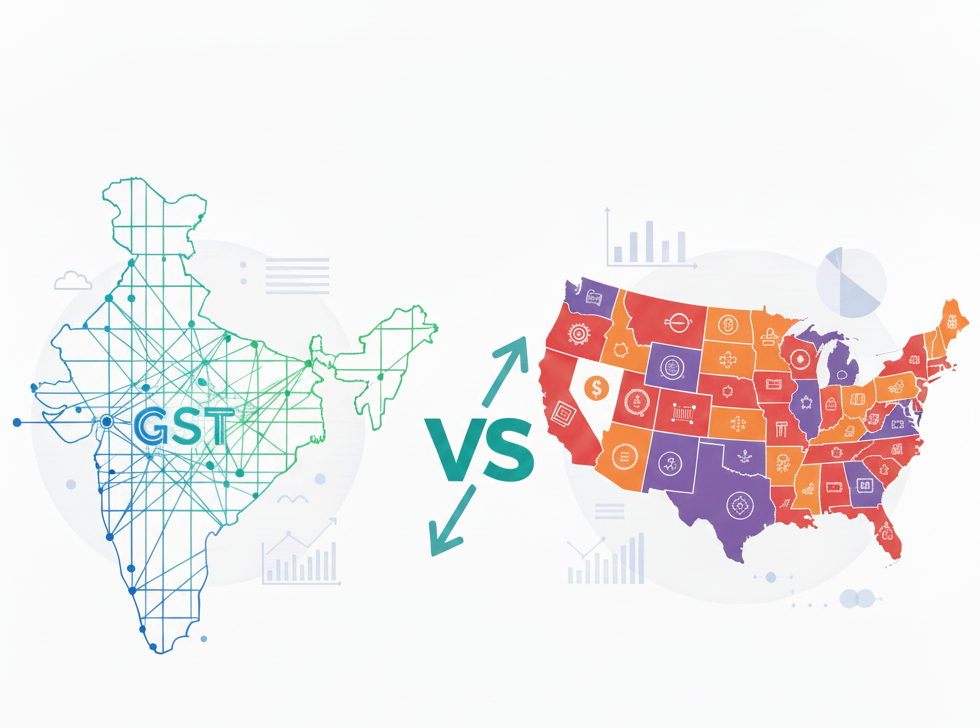
Starting a business in the U.S. is one of the smartest moves for Indian founders—but before you register your U.S. company, there’s one topic that creates maximum confusion: GST vs U.S. Sales Tax.
Most Indian entrepreneurs assume the U.S. has a GST-like central tax system.
But the truth?
The U.S. has NO national GST. Instead, it follows a state-wise Sales Tax system, and understanding it is crucial before incorporating your LLC or C-Corp.
In this guide, we break down everything Indian founders must know so you can incorporate confidently, price correctly, and stay 100% compliant.
If you want to avoid penalties, wrong tax collection, or rejected payments, read this till the end.
1. Why Indian Founders Get Confused About GST & U.S. Sales Tax
In India, everything feels simple:
- One central system → GST
- One registration → PAN + GSTIN
- One tax structure for goods & services
But in the U.S., things are completely different.
Different states…
Different tax rules…
Different compliance deadlines…
This is why Indian founders often make early mistakes that cost thousands later.
Before you start your U.S. incorporation, let’s simplify everything.
2. What Is GST? (Quick Refresher for Indian Founders)
GST (Goods and Services Tax) is India’s centralized tax on goods and services, with CGST, SGST and IGST
GST applies to almost all businesses above the threshold and is uniform across states.
In India:
- A product/service has ONE GST rate
- Registration rules are simple
- Returns are centralized
- Input tax credit is available
This creates a false assumption that U.S. taxation works similarly.
But it doesn’t.
3. What Is U.S. Sales Tax? (Founder-Friendly Explanation)
Key aspects:
- It is state-level, not federal
- Every state (and sometimes city) chooses its own tax rate
- Some states have 0% sales tax
- Some states have 10%+ sales tax
Example:
- Delaware → 0%
- New York → ~8.875%
- California → ~7.25–10.25%
<Rates shown are combined state + local rates and may vary by city and county.>
So, if you incorporate a Delaware LLC, your business structure may have zero sales tax obligations inside Delaware — but you can still trigger Sales Tax in other states depending on where you sell.
This is where the word Nexus becomes important.
4. GST vs U.S. Sales Tax – Quick Comparison Table
| Feature | GST (India) | U.S. Sales Tax |
| Tax Type | Central, unified | State-level (varies by state) |
| Rates | Fixed slabs nationwide | 0% to 10%+ depending on state/county |
| Applies On | Goods & services | Mostly goods; some services |
| Registration | Single GSTIN | Multiple states may require registration |
| Tax Credit | Input Tax Credit available | No tax credits |
| Complexity | Moderate | Very high for eCommerce & SaaS |
| Compliance | Monthly/quarterly returns | State-by-state filings |
| Threshold | ₹40L / ₹20L | Varies by state |
This table alone clears 70% confusion Indian founders have before U.S. incorporation.
5. Understanding Nexus – The Most Important Term
Nexus
You create “Sales Tax Nexus” if:
- You cross a revenue threshold (e.g., $100,000 in sales)
- You sell more than a specific number of transactions
- You store inventory in a state (Amazon FBA issue)
- You have contractors/employees in a state
- You have an office/warehouse
For SaaS and digital services:
Some states consider SaaS as a taxable product → you must collect Sales Tax.
This affects most Indian founders selling:
- SaaS products
- Digital tools
- Online courses
- E-commerce items
- Subscription apps
Before registering your USA company, you must know which states may create nexus for your business model.
6. Do Indian Companies Need to Pay Sales Tax?
Yes — if they sell to U.S. customers and trigger nexus.
Many Indian entrepreneurs wrongly assume:
“If I am outside the U.S., I don’t need to pay U.S. sales tax.”
This is completely incorrect.
If you sell in California, Texas, New York andFlorida
…you may need to collect tax from customers and file to the state, even if your company is in India.
Your place of incorporation does NOT decide Sales Tax — your selling location does.
7. When Indian Founders Must Register for U.S. Sales Tax
You must register when you:
- Sell goods physically delivered in USA
- Provide taxable digital services
- Cross state nexus thresholds
- Run Shopify/Amazon/eCommerce targeting U.S. buyers
- Use warehouses in the U.S.
- Sell SaaS to customers located in taxable states
- Skipping registration leads to: Penalties, Back taxes, Blocked payment gateways and Account freezes (Stripe/PayPal)
Founders usually realize this late during funding or due diligence, and face huge cleanup costs.
8. State-Wise Sales Tax Examples (For Founders Planning State Registration)
| State | Approx Sales Tax Rate | SaaS Taxable? | Notes |
| Delaware | 0% | No | Startup-friendly |
| Wyoming | 4–6% | No | Popular for LLCs |
| Texas | ~6.25% | Yes | SaaS is taxable |
| California | 7.25–10.25% | Sometimes | Complex rules |
| New York | 8.875% | Yes | Strict nexus enforcement |
This shows why state selection affects your long-term tax cost.
9. GST vs U.S. Sales Tax for SaaS & Digital Startups
GST on SaaS in India:
- Treated as a “service”
- GST applicable depending on place of supply
U.S. Sales Tax on SaaS:
- Taxable in many states
- Non-taxable in others
- Highly inconsistent
For SaaS founders, correct state selection + proper incorporation planning is crucial.
10. Common Mistakes Indian Entrepreneurs Make
Most early-stage founders make 5 major mistakes:
1. Believing the U.S. has GST
→ Incorrect; the U.S. has state-level sales tax.
2. Not understanding nexus
→ Leads to penalties & back taxes.
3. Choosing states randomly
→ State choice must match business model + tax exposure.
4. Using personal Indian bank accounts
→ Triggers compliance red flags.
5. Collecting wrong taxes on Shopify/WooCommerce
→ Leading to blocked accounts.
These mistakes can be avoided with proper U.S. advisory or a Virtual CFO.
11. How Sales Tax Affects Your U.S. Company Type (LLC vs C-Corp)
LLC
- Pass-through taxation
- Easier compliance
- Good for small to medium founders
Still liable for Sales Tax based on nexus
C-Corp
- Required for raising VC
- Separate taxation
- Clearer compliance for SaaS at scale
- Nexus rules remain same
No matter which entity you choose → Sales Tax rules follow your selling location, not business structure.
12. Compliance Checklist Before Incorporation
Before registering your U.S. company, ensure you’re clear about:
l Choosing the right state (Delaware/Wyoming/Nevada)
l Knowing your nexus exposure
l Sales tax approach for your business model
l Required registrations in different states
l Accounting + bookkeeping setup
l Whether you need a U.S. Virtual CFO
<Payment gateway tax configuration (Stripe/PayPal/Amazon)
Exemption certificate management (resale, SaaS B2B exemptions)>
This avoids expensive mistakes later.
13. How USAIndiaCFO Helps Indian Founders Stay 100% Compliant
Your blog objective is to drive leads — so here is an authority-based, soft CTA:
At USAIndiaCFO, founders get everything under one roof:
- S. company incorporation
- EIN / ITIN
- Sales Tax advisory
- Monthly compliance & filings
- State-wise registration
- Accounting + bookkeeping
- Virtual CFO services
- Tax savings strategy
- Legal documentation
This ensures your business is compliant from day one, without dealing with U.S. tax complexities alone.
14. Conclusion
Understanding GST vs U.S. Sales Tax is not optional — it’s a foundational step before you incorporate a company in the U.S. The right clarity today helps you:
- avoid future penalties
- choose the right state
- price your products correctly
- stay compliant
- scale confidently in the U.S.
If you’re planning to start your U.S. company soon, get professional guidance before registering.
Incorporate Your Company in the USA — Start Now
Register Your U.S. Company From India — 24-Hour Filing Support
FAQs
Does the USA have GST like India?
No. The U.S. does not have a national GST. Instead, every state has its own Sales Tax rules, rates, and filing requirements.
Do Indian founders need to collect U.S. Sales Tax?
Yes, if they sell to U.S. customers and create Nexus in any state. Selling from India does not exempt you.
Which U.S. states have zero sales tax?
Delaware, Montana, Oregon, and New Hampshire have 0% Sales Tax. Many founders choose Delaware for this reason.
Is SaaS taxable in the U.S.?
Yes, In many states. Texas, New York, and Pennsylvania tax SaaS. Wyoming and Delaware do not.
Does choosing a Delaware LLC remove Sales Tax obligations?
No. Sales Tax depends on where your customers are located, not where your company is incorporated.
Do I need an ITIN for Sales Tax?
Not always. ITIN is for federal tax filing. Sales Tax registration depends on state rules.
How do I stay 100% compliant while selling in the U.S.?
By registering correctly for Sales Tax, filing on time, choosing the right state for incorporation, and maintaining clean accounting, ideally with a U.S. Virtual CFO.