

Introduction
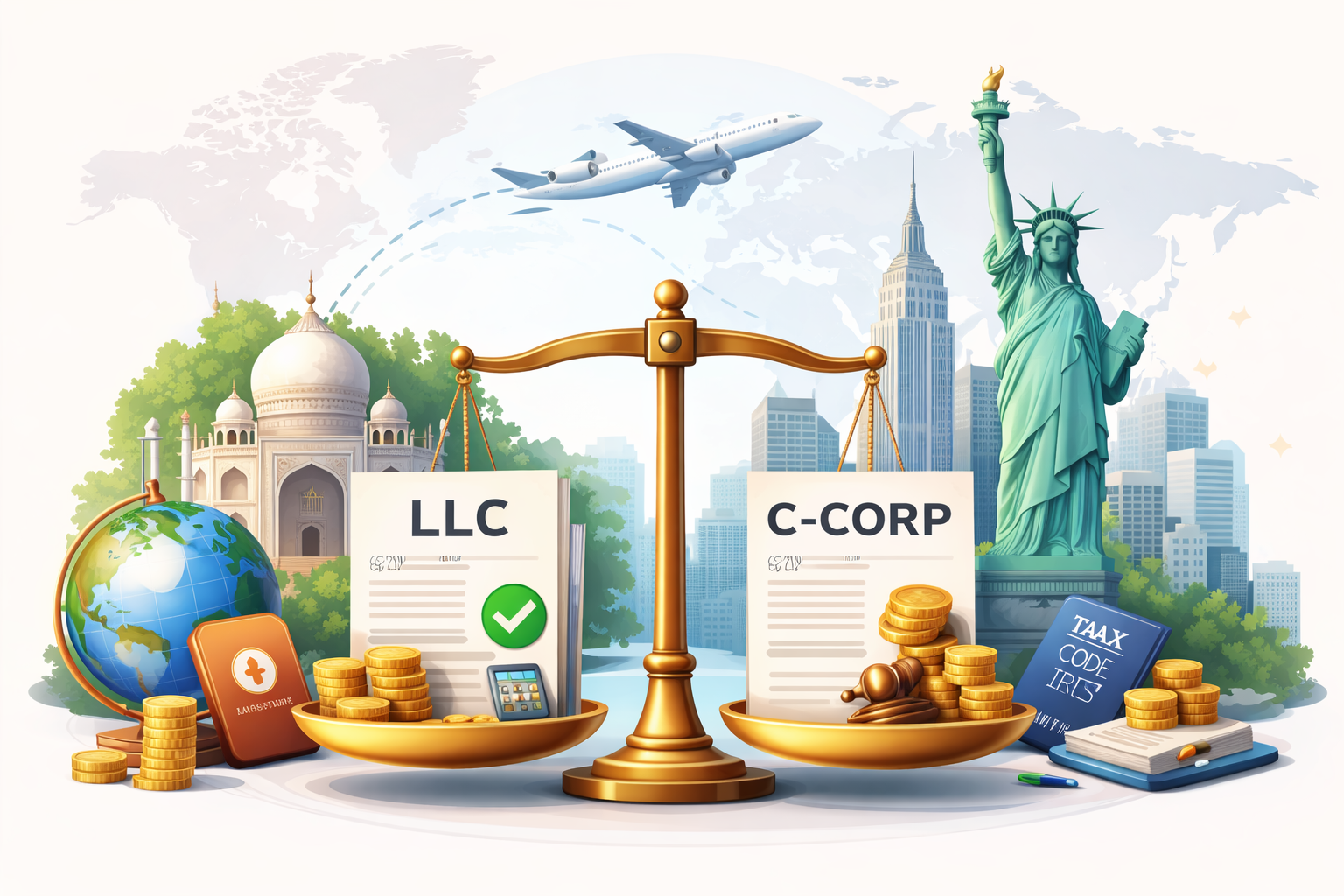
Over the past few years, a growing number of Indian entrepreneurs have been expanding globally by registering companies in the United States. The U.S. market offers easier access to international clients, payment gateways, venture capital funding, and strong brand credibility. However, one of the biggest early decisions founders must make is choosing between an LLC vs C Corp for Indian founders, a choice that significantly impacts taxation, compliance, and long-term scalability.
Many founders select a business structure based on what they hear from peers or advisors without fully understanding the financial consequences. This is where costly mistakes often occur, especially around the concept of double taxation. Selecting the wrong structure can result in unnecessary tax exposure both in the United States and India.
This practical guide breaks down the differences between a US LLC vs C Corporation, explains how taxation works for non-resident Indian founders, and helps you choose the best structure for your business goals in 2026 and avoiding the double taxation trap before registering a US company.
Can Indian Founders Legally Register an LLC or C-Corporation in the USA?
Yes. Indian citizens can legally own 100% of a U.S. company without holding U.S. residency or citizenship. There is no legal restriction preventing non-resident entrepreneurs from forming either an LLC or a C-Corporation.
To incorporate successfully, Indian founders generally need:
- A registered agent with a U.S. address
- Employer Identification Number (EIN) issued by the IRS
- Chosen state of incorporation (commonly Delaware or Wyoming)
This flexibility makes the United States one of the most accessible jurisdictions for global founders. However, ownership does not eliminate tax responsibilities. Once the company starts earning revenue, U.S. tax compliance and reporting obligations apply.
Understanding how US company tax for non residents works is essential before deciding which structure to choose.
What Is a U.S. LLC? Structure, Taxation & Benefits for Indian Entrepreneurs
A Limited Liability Company (LLC) is one of the most popular entity types for small and mid-sized businesses.
How an LLC Works
An LLC provides limited liability protection, meaning the owner’s personal assets are generally protected from business liabilities. The structure is flexible and can be owned by a single member or multiple partners.
For Indian founders operating service businesses such as consulting, IT, or digital services, an LLC is often the simplest starting structure.
Pass-Through Taxation Explained
The key feature of an LLC is pass-through taxation. Instead of paying corporate tax at the entity level, profits pass through to the owner and are taxed as personal income.
For non-resident founders:
- The LLC itself may not pay federal corporate tax.
- Income is reported by the owner depending on the business activity and tax treaties.
- Filing requirements may still exist in the U.S.
This structure avoids one layer of taxation but requires careful planning to manage reporting obligations in both countries.
Advantages of an LLC for Indian Founders
- Lower compliance costs
- Simplified accounting requirements
- Flexible ownership
- Easier maintenance
- Ideal for bootstrapped startups
For early-stage entrepreneurs focused on profitability rather than external investment, an LLC is often the most practical choice.
What Is a C-Corporation? Tax Structure, Funding Benefits & Compliance
A C-Corporation (C-Corp) is a separate legal entity owned by shareholders.
Separate Legal Entity Explained
Unlike an LLC, a C-Corp exists independently from its owners. This structure allows:
- Issuance of shares
- Multiple investors
- Venture capital funding
- Employee stock option plans
Because of these features, venture-backed startups typically choose the C-Corp structure.
Corporate Taxation Overview
A C-Corp pays corporate tax at the federal and sometimes state level. After tax is paid on profits, any dividends distributed to shareholders may be taxed again.
This leads to the concept known as double taxation.
Why Investors Prefer Delaware C-Corp
The Delaware C Corp vs LLC debate often favors C-Corporations when raising funding because:
- Delaware has business-friendly laws
- Investors prefer standardized corporate governance
- Shares are easier to issue and transfer
If your long-term plan involves venture capital or acquisition, a C-Corp structure can provide strategic advantages.
The “Double Taxation” Trap Explained Simply
One of the biggest concerns when comparing US LLC vs C Corporation is the risk of double taxation.
What Is Double Taxation?
Double taxation occurs when:
- The corporation pays tax on its profits.
- Shareholders pay tax again when dividends are distributed.
For example:
- A C-Corp earns $100,000 in profit.
- Corporate tax is applied.
- Remaining profit distributed as dividend.
- Shareholder pays tax again in India.
Does Double Taxation Apply to Indian Founders?
Indian founders may benefit from the India-US DTAA (Double Taxation Avoidance Agreement), which reduces certain tax burdens such as withholding tax rates. However, it does not eliminate all taxation layers.
This means:
- Corporate profits remain taxable in the U.S.
- Dividends may still be taxable in India
Without proper structuring and financial planning, founders may pay significantly more tax than necessary.
LLC vs C-Corp Tax Comparison for Indian Owners
Below is a simplified comparison:
| Factor | LLC | C-Corporation |
|---|---|---|
| Taxation | Pass-through | Corporate + Dividend Tax |
| Compliance | Lower | Higher |
| Funding Readiness | Limited | High |
| Annual Cost | Lower | Higher |
| Ownership Flexibility | High | Structured |
| Investor Preference | Low | Very High |
When analyzing LLC vs C Corp tax comparison, Indian founders must evaluate both current profitability and future funding plans.
Compliance Requirements: LLC vs C-Corporation
Regardless of entity type, compliance is mandatory.
LLC Compliance
- Annual state filings
- IRS reporting forms
- Accounting records
C-Corp Compliance
- Corporate tax filing
- Shareholder reporting
- Board documentation
- Payroll compliance
A C-Corp generally requires more formal governance and financial reporting.
Understanding US compliance requirements is critical to avoid penalties and maintain good standing.
Which Business Structure Should Indian Founders Choose in 2026?
There is no one-size-fits-all answer. The best structure depends on business goals.
Choose an LLC If:
- You are running a service or consulting business
- You want lower compliance cost
- You are bootstrapping
- You prioritize profitability
Choose a C-Corp If:
- You plan to raise venture capital
- You want global scaling
- You intend to offer ESOPs
- You expect multiple investors
The best US business structure for Indian entrepreneurs depends on growth strategy, funding plans, and tax optimization.
Common Mistakes Indian Entrepreneurs Make
Many founders make avoidable errors such as:
- Selecting structure based on popularity
- Ignoring taxation implications
- Not considering India-US reporting requirements
- Failing to plan long-term funding strategy
These mistakes can lead to higher costs and restructuring later.
How Virtual CFO Services Help Avoid Tax & Compliance Risks
Cross-border financial planning is complex. A specialized advisory partner or Virtual CFO services USA provider can:
- Recommend the correct entity structure
- Plan tax optimization
- Manage compliance deadlines
- Provide financial reporting
Having ongoing advisory support ensures founders remain compliant while focusing on growth.
Conclusion
Choosing between an LLC and a C-Corporation is one of the most critical decisions Indian founders make when expanding into the U.S. market. The structure you select determines your tax exposure, compliance workload, and funding opportunities.
While an LLC offers simplicity and lower cost, a C-Corp provides scalability and investor confidence. However, founders must clearly understand the implications of double taxation before proceeding.
Before incorporating, it is advisable to evaluate your long-term business goals and consult cross-border financial experts who understand both U.S. and Indian regulations.
Making the right choice today can save significant tax, compliance effort, and restructuring costs in the future.
Get personalized guidance from USA–India compliance specialists before you register your U.S. company. Book free Consultation now!
FAQ
Is an LLC or C-Corp better for Indian founders?
An LLC is usually better for service-based or bootstrapped businesses due to lower compliance and pass-through taxation, while a C-Corp is preferred for startups planning to raise investment.
Do Indian owners pay U.S. taxes twice?
In a C-Corp structure, corporate profits are taxed first and dividends may be taxed again in India, although the India-US DTAA may reduce the overall burden.
Can an LLC be converted into a C-Corporation later?
Yes. Many startups begin as LLCs and later convert to C-Corps when seeking venture capital funding.
Is Delaware mandatory for U.S. incorporation?
No, but Delaware is popular due to investor-friendly laws and established corporate governance frameworks.
How much tax does a U.S. company pay if owned from India?
Tax liability depends on entity structure, income source, and treaty benefits. Corporate tax applies to C-Corps, while LLC taxation varies based on pass-through rules.
Which structure is best for fundraising?
Investors typically prefer Delaware C-Corporations because they allow equity issuance and standardized shareholder rights.